
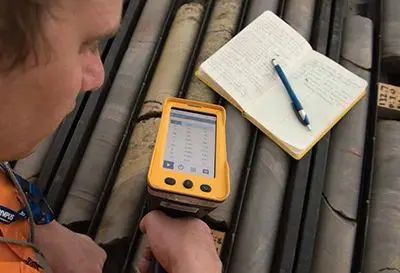
Handheld XRF Analyser: Fast Alloy Composition Testing
The Speed Advantage in Alloy Testing
Seconds to Complete Analysis
Handheld XRF analysers achieve remarkable analysis speeds that revolutionize alloy testing workflows. Grade identification—determining whether a sample is stainless steel 316L, aluminum 6061, or titanium Grade 5—completes in just 2-5 seconds. This rapid screening enables high-throughput applications where hundreds or thousands of components require verification.
Comprehensive quantitative analysis measuring precise elemental percentages for all alloying elements typically requires 10-30 seconds depending on required precision and element list. Even this extended analysis represents dramatic acceleration compared to traditional laboratory methods requiring sample preparation, chemical dissolution, and instrumental analysis consuming hours or days.
The speed comes from advanced detector technology—silicon drift detectors (SDD) with high count rate capability exceeding 100,000-500,000 counts per second. These detectors rapidly accumulate sufficient X-ray fluorescence signals for statistically reliable results. Powerful X-ray sources generate intense fluorescence from samples, maximizing signal strength and minimizing required measurement time.
Real-Time Decision Making
The instantaneous nature of handheld XRF analysis enables real-time decision-making impossible with laboratory-dependent testing. Production supervisors verify incoming alloy shipments immediately upon delivery, accepting or rejecting materials before unloading begins. Fabricators confirm correct alloy selection before expensive machining operations start. Welders check filler metal grades before initiating critical welds.
This immediate feedback prevents errors from propagating through manufacturing processes. Catching incorrect alloys during receiving inspection costs only return shipping. Discovering the same error after machining, welding, or installation multiplies costs exponentially through wasted labor, scrapped components, rework, and project delays. Fast alloy testing acts as a quality gate preventing problems before they become expensive.
Comprehensive Alloy Analysis Capabilities
Stainless Steel Identification and Analysis
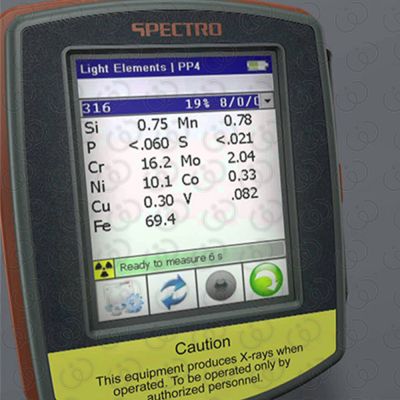
Handheld XRF analysers excel at stainless steel testing, accurately identifying and quantifying the complex compositions that define hundreds of grades. The instruments measure iron as the base element plus critical alloying elements including chromium (typically 10-30%), nickel (0-35%), molybdenum (0-8%), manganese (0-10%), and trace additions of copper, nitrogen proxies, and other constituents.
This comprehensive analysis distinguishes similar grades separated by subtle compositional differences. The analyser differentiates austenitic 304 (18% Cr, 8% Ni, no Mo) from 316 (18% Cr, 10% Ni, 2-3% Mo) from 321 (18% Cr, 9% Ni, titanium stabilized). Ferritic grades like 430, duplex stainless steels like 2205, and precipitation-hardening varieties all receive accurate identification.
The ability to measure multiple alloying elements simultaneously enables verification against tight specifications. Users confirm not just that chromium and nickel fall within acceptable ranges, but that molybdenum, manganese, silicon, and all specified elements meet requirements—complete compositional verification from single rapid measurements.
Aluminum Alloy Testing
Aluminum alloy analysis presents challenges due to aluminum's relatively light atomic weight and low-percentage alloying additions, but modern handheld XRF analysers reliably identify aluminum grades through precise measurement of silicon, magnesium, copper, manganese, zinc, chromium, and other alloying elements.
The technology distinguishes wrought aluminum series by their characteristic alloying patterns: 2xxx series (copper-bearing for aerospace), 5xxx series (magnesium-bearing for marine), 6xxx series (magnesium-silicon for extrusions), and 7xxx series (zinc-bearing for high strength). Cast aluminum alloys with higher silicon contents receive accurate identification. Specific grades within series—separating 6061 from 6063, or 7075 from 7050—require measuring subtle compositional variations that handheld XRF systems detect reliably.
This aluminum testing capability supports aerospace component verification, automotive quality control, construction material inspection, and recycling operations where aluminum grade segregation impacts material value significantly.
Titanium, Copper, and Specialty Alloys
Handheld XRF analysers identify titanium grades including commercially pure titanium (Grades 1-4) and alloys like Ti-6Al-4V (Grade 5) by measuring aluminum, vanadium, iron, and other alloying additions. This capability supports aerospace, medical device, and chemical processing applications where titanium's corrosion resistance and strength-to-weight ratio justify premium costs—and where alloy verification ensures performance requirements are met.
Copper alloy testing distinguishes brasses (copper-zinc), bronzes (copper-tin), cupronickel (copper-nickel), and specialized compositions containing aluminum, silicon, or lead. The analysers measure copper content plus alloying additions that determine mechanical properties, corrosion resistance, and application suitability.
Nickel-based superalloys (Inconel, Hastelloy, Monel), cobalt alloys, tool steels, and other specialty compositions all undergo rapid identification and quantification. This versatility makes handheld XRF the universal alloy testing solution across metal industries.
Advanced Features Enabling Fast Testing
High-Performance Detector Systems
Silicon drift detectors represent the technological foundation enabling fast, accurate alloy testing. These advanced semiconductor detectors achieve energy resolution around 125-140 eV FWHM (full width at half maximum), clearly separating closely-spaced spectral peaks from different elements. Superior resolution means accurate identification even in complex multi-element alloys where spectral overlaps might confuse less capable systems.
The high count rate capability allows these detectors to process hundreds of thousands of X-ray photons per second without saturation or resolution degradation. This throughput capacity enables rapid accumulation of statistically significant data—the foundation of both speed and accuracy in alloy analysis.
Thermoelectric (Peltier) cooling maintains stable detector temperature for consistent performance without liquid nitrogen or other cryogenic requirements. This practical cooling approach makes sophisticated detector technology viable in portable, field-deployable instruments.
Optimized X-Ray Sources
Miniature X-ray tubes in handheld analysers generate intense, precisely controlled X-ray beams that efficiently excite fluorescence in metal samples. Variable voltage (typically 4-50 kV) and current settings optimize excitation for different elements and alloys—lower energies for aluminum and magnesium, higher energies for heavy elements and high-alloy steels.
Modern tubes deliver sufficient power for rapid analysis while operating from battery power. The combination of efficient excitation and sensitive detection minimizes required measurement time without sacrificing analytical quality. Users select analysis modes balancing speed against precision—quick screening for sorting applications, extended measurement for certification-quality results.
Intelligent Software and Grade Libraries
Sophisticated analytical software performs real-time spectral processing, background subtraction, peak deconvolution, and quantitative calculations during measurement. Advanced algorithms automatically correct for matrix effects where one element's presence affects measured intensities of others, ensuring accurate quantification across diverse alloy compositions.
Comprehensive grade libraries contain thousands of international alloy specifications (ASTM, EN, DIN, JIS, GB, GOST) against which the analyser automatically compares measured compositions. When detecting 18% chromium, 8% nickel, 0.08% carbon proxy, minimal molybdenum in an iron-based alloy, the software instantly identifies this as stainless steel 304 and displays the result.
Custom calibrations enable users to develop application-specific methods for specialized alloys or unique testing requirements. This flexibility extends analytical capabilities beyond standard factory calibrations.
Critical Applications for Fast Alloy Testing
High-Volume Scrap Sorting
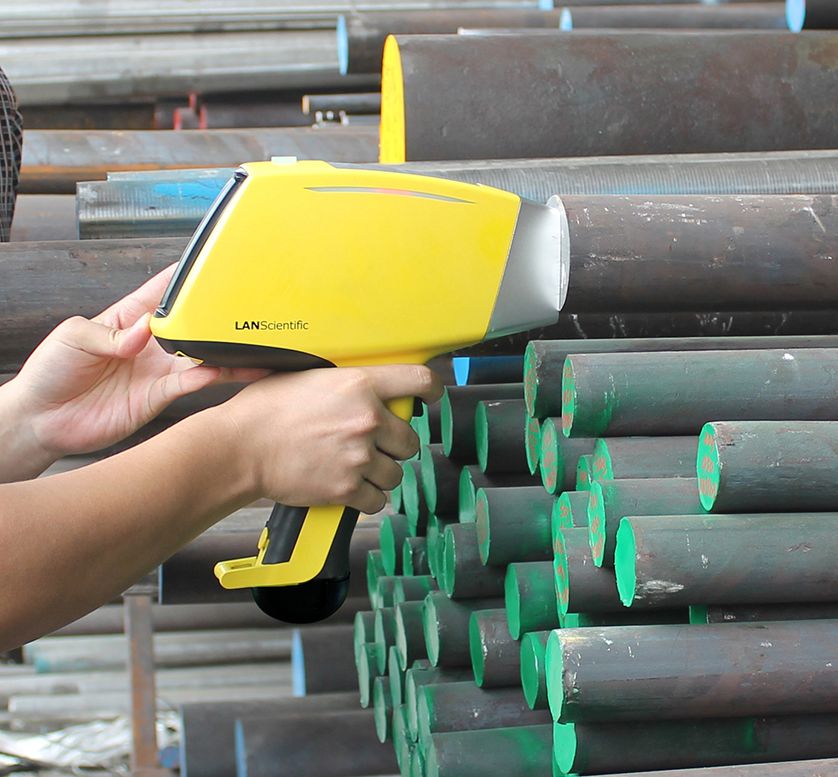
Scrap metal recycling demands maximum sorting speed to process thousands of pieces per shift economically. Handheld XRF analysers enable operators to test items in 2-5 seconds each, rapidly segregating mixed scrap into homogeneous alloy lots. The speed translates directly to throughput—one operator with a handheld analyser can sort 500-1000 pieces per shift, creating properly segregated material commanding premium prices.
The fast testing prevents bottlenecks in recycling operations. Material flows continuously through sorting stations with instant alloy identification guiding placement into appropriate bins. This efficiency maximizes facility capacity while improving segregation accuracy that increases material value.
Production Line Quality Control
Manufacturing environments integrate fast alloy testing into production workflows without slowing throughput. Inspectors test components directly on production lines, verifying correct material usage in seconds without removing parts from the manufacturing flow. This inline testing prevents entire batches of incorrect material from progressing through expensive processing steps.
The non-destructive testing preserves finished products. Quality control teams verify final assemblies, machined components, and finished parts without creating scrap. The rapid verification supports high-volume production where testing must keep pace with manufacturing speed.
Field PMI Inspections
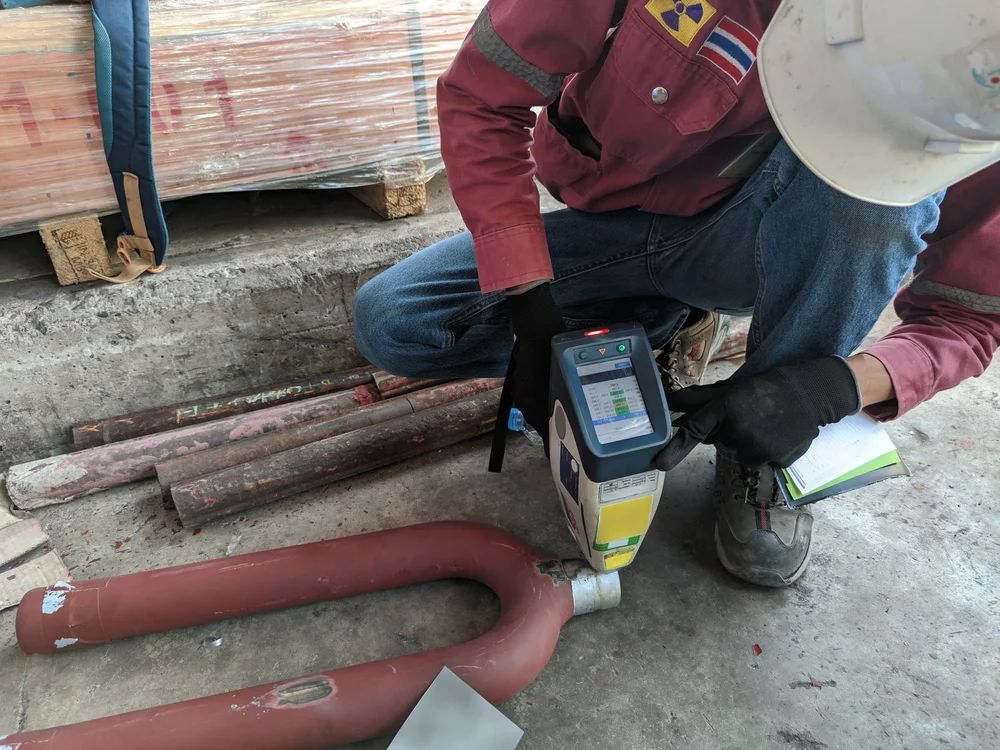
Construction site PMI programs test thousands of components during facility construction. Fast alloy analysis enables inspectors to complete comprehensive verification within project schedules. Testing piping systems, pressure vessels, structural steel, and equipment components in place requires no disassembly—inspectors simply position analysers against accessible surfaces and receive instant grade identification.
The speed allows 100% inspection rates rather than statistical sampling. Every weld, every flange, every critical component receives verification, creating complete quality documentation that regulatory requirements and project specifications demand.
Accuracy Meets Speed
Fast analysis means nothing without accuracy, and modern handheld XRF analysers deliver both. Measurement precision typically reaches 0.1-0.3% for major alloying elements—sufficient accuracy for distinguishing similar grades, verifying specifications, and ensuring quality. This performance matches or exceeds many laboratory techniques while delivering results hundreds of times faster.
The speed-accuracy combination comes from technological advances: high-performance detectors with superior resolution and count rates, powerful X-ray sources maximizing fluorescence intensity, and sophisticated software optimizing every aspect of measurement and data processing. These integrated improvements enable reliable analysis in timeframes that seemed impossible just years ago.
Users no longer face the traditional trade-off between speed and quality. Modern handheld XRF provides both—accurate enough for certification and compliance, fast enough for high-volume sorting and real-time quality control.
Selecting Fast Alloy Testing Equipment
Choose handheld XRF analysers based on alloy types, testing volume, required speed, and accuracy needs. All modern analysers provide rapid testing, but performance varies. Evaluate detector technology—silicon drift detectors deliver superior speed-accuracy combinations. Assess grade library coverage ensuring the instrument recognizes alloys you'll encounter.
Consider operational environment—rugged construction with appropriate environmental ratings suits harsh industrial conditions. Battery life matters for high-volume testing—ensure capacity supports your workflow without frequent recharging interruptions.
Request demonstrations with your actual alloys and materials. Real-world testing reveals whether analysis speed meets operational requirements and accuracy satisfies quality standards. Verify manufacturer support including training, calibration services, and technical assistance.
Conclusion
Handheld XRF analysers have revolutionized alloy composition testing by delivering laboratory-quality analysis in seconds rather than days. This dramatic speed improvement transforms quality control workflows, enabling real-time decision-making, 100% inspection rates, and immediate problem prevention that keeps operations efficient while ensuring material quality.
The combination of 2-5 second grade identification and 10-30 second comprehensive quantitative analysis makes handheld XRF suitable for applications from high-volume scrap sorting to critical aerospace component verification. The technology's ability to rapidly identify stainless steels, aluminum alloys, titanium, copper alloys, and specialty compositions—all from a single portable instrument—provides complete alloy testing capabilities wherever and whenever needed.
As detector technology advances, software capabilities expand, and analytical methods improve, handheld XRF analysers continue getting faster without sacrificing accuracy. For organizations requiring rapid alloy verification that prevents costly errors, supports regulatory compliance, and optimizes operational efficiency, handheld XRF analysers deliver the fast, accurate composition testing that modern metal industries demand. The investment returns value through prevented material mix-ups, accelerated quality control, improved scrap sorting profitability, and the confidence that comes from knowing exactly what alloys you're working with—instantly, accurately, and on-site.
Related posts
-
 XRF Analyzer: Portable Metal Composition Tester
Portable XRF analyzers have revolutionized metal composition testing by delivering laboratory-quality elemental...Einzelheiten
XRF Analyzer: Portable Metal Composition Tester
Portable XRF analyzers have revolutionized metal composition testing by delivering laboratory-quality elemental...Einzelheiten -
 XRF Fluorescence Analyzer: Material Testing Device
XRF fluorescence analyzers stand as versatile material testing devices that revolutionize how industries analyze...Einzelheiten
XRF Fluorescence Analyzer: Material Testing Device
XRF fluorescence analyzers stand as versatile material testing devices that revolutionize how industries analyze...Einzelheiten -
 Handheld XRF Analyzer: ElvaX ProSpector Metal Scanner
The ElvaX ProSpector represents a cutting-edge advancement in handheld XRF analyzer technology, combining...Einzelheiten
Handheld XRF Analyzer: ElvaX ProSpector Metal Scanner
The ElvaX ProSpector represents a cutting-edge advancement in handheld XRF analyzer technology, combining...Einzelheiten -
 Portable XRF Analyzer: Metalworking Field Testing
Metalworking demands speed and precision—materials arrive, parts get fabricated, components are installed, all on...Einzelheiten
Portable XRF Analyzer: Metalworking Field Testing
Metalworking demands speed and precision—materials arrive, parts get fabricated, components are installed, all on...Einzelheiten -
 Buy XRF Analyzer: ElvaX ProSpector 2026 Prices
Investing in a handheld XRF analyzer represents a significant commitment for any organization, and understanding...Einzelheiten
Buy XRF Analyzer: ElvaX ProSpector 2026 Prices
Investing in a handheld XRF analyzer represents a significant commitment for any organization, and understanding...Einzelheiten