
XRF Spectroscopy Equipment & Instrumentation
Essential Components of XRF Instruments
X-Ray Source: The Excitation System
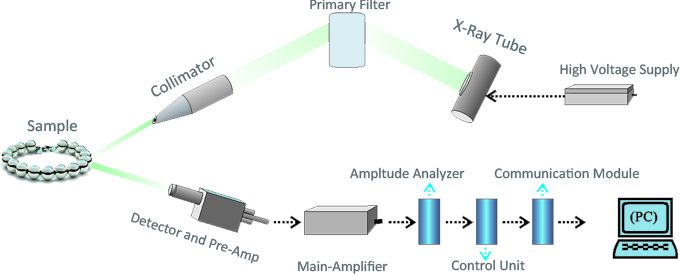
Every XRF spectrometer requires a source of high-energy X-rays to excite fluorescence in samples. The X-ray tube represents the most common source, generating X-rays by accelerating electrons toward a metal target (anode). When high-speed electrons strike the target, they produce X-rays through two mechanisms: characteristic X-ray lines from the target material itself (typically rhodium, tungsten, molybdenum, or silver), and continuous bremsstrahlung radiation across a broad energy range.
The choice of target material significantly affects instrument performance for different applications. Rhodium targets provide excellent general-purpose performance across most elements. Tungsten targets generate higher-energy X-rays ideal for heavy element analysis. Silver targets optimize light element excitation. The tube's operating voltage (typically 4-50 kV) and current (0.01-2 mA) can be adjusted to optimize excitation efficiency for specific elements or sample types.
Modern miniature X-ray tubes enable handheld instrument designs by combining high performance with compact size and low power consumption. These tubes operate on rechargeable batteries, delivering sufficient excitation for field analysis while weighing just grams. Benchtop systems employ larger, more powerful tubes generating higher X-ray intensities that improve detection limits and reduce analysis times.
A thin beryllium window seals the X-ray tube while allowing X-rays to exit toward the sample. This window must be thin enough (typically 25-125 micrometers) to transmit low-energy X-rays while strong enough to maintain vacuum inside the tube.
Detector Technology: Measuring Fluorescence
Detectors measure the energy and intensity of fluorescent X-rays emitted from samples, transforming X-ray photons into electrical signals for processing. Detector performance—energy resolution, detection efficiency, count rate capability—fundamentally determines overall instrument analytical capabilities.
Silicon drift detectors (SDD) represent current state-of-the-art technology for most XRF applications. These solid-state semiconductor detectors achieve exceptional energy resolution around 125-140 eV FWHM (full width at half maximum) while handling high count rates exceeding 100,000 counts per second. SDDs operate with thermoelectric (Peltier) cooling rather than liquid nitrogen, eliminating cryogenic requirements and enabling portable instrument designs.
When an X-ray photon enters the SDD, it creates electron-hole pairs in the silicon crystal. The number of electrons produced is proportional to the X-ray energy—higher energy X-rays generate more electrons. The detector collects these electrons and converts them into voltage pulses. A multi-channel analyzer then sorts pulses by size (equivalent to X-ray energy), building up the characteristic energy spectrum used for elemental identification and quantification.
Older PIN diode detectors still appear in some instruments, offering lower cost but inferior resolution (typically 180-250 eV) and reduced sensitivity. For wavelength-dispersive XRF (WDXRF) systems, proportional counters or scintillation detectors measure X-rays after crystal diffraction separates them by wavelength.
Sample Chamber and Measurement Geometry
The sample chamber positions samples at optimal geometry relative to the X-ray source and detector, maximizing fluorescent X-ray collection while minimizing background scatter. Benchtop systems typically employ downward-looking geometry where the X-ray tube and detector mount above a sample positioned on a motorized stage. This configuration accommodates samples of varying sizes and shapes.
Handheld analyzers integrate all components—tube, detector, shielding, electronics—into a single handheld unit that users position directly against samples. The measurement window contacts the sample surface, with internal geometry optimized for the compact form factor.
Safety shielding surrounds the X-ray source and sample chamber, preventing radiation exposure to operators. Benchtop systems incorporate interlocked doors that automatically shut off X-rays when opened. Handheld units employ shielding and proximity sensors that activate X-rays only when properly positioned against samples and trigger buttons are pressed.
Signal Processing and Control Electronics
Sophisticated electronics amplify detector signals, digitize voltage pulses, and process data to generate energy spectra. The multi-channel analyzer (MCA) bins pulses by energy, accumulating counts at each energy level to build the characteristic spectrum. Modern digital signal processing achieves superior performance through precise pulse shaping, pile-up rejection, and baseline correction.
Control systems manage tube voltage and current, regulate detector temperature, coordinate measurement sequences, and handle data storage and communication. Embedded computers run analytical software that identifies elements, applies calibrations, performs quantitative calculations, and presents results to users through intuitive interfaces.
Types of XRF Instrumentation
Handheld Portable Analyzers
Handheld XRF analyzers revolutionized elemental analysis by bringing laboratory-quality measurements to field locations. These portable instruments weigh 1.2-1.8 kilograms and operate on rechargeable batteries providing 8-12 hours of continuous use. Despite their compact size, modern handheld analyzers deliver performance rivaling benchtop systems for many applications.
The portability enables testing exactly where materials exist—on production floors, at construction sites, in warehouses, at scrap yards, or in remote mining locations. No sample transport, no laboratory delays—results appear in seconds directly on the analyzer's touchscreen display. This immediate feedback supports real-time decision-making that keeps operations flowing efficiently.
Handheld analyzers excel at metal alloy identification (positive material identification/PMI), scrap sorting, environmental soil screening, precious metals verification, and quality control inspection. The rugged construction withstands harsh industrial environments including dust, moisture, temperature extremes, and physical impacts.
Limitations include slightly lower accuracy compared to benchtop systems, particularly for light elements (magnesium, aluminum, silicon) without helium purging or vacuum operation. Surface-level analysis depth (10-100 micrometers) means coatings, plating, or surface contamination can affect results if not properly addressed.
Benchtop Laboratory Systems
Benchtop XRF spectrometers provide superior analytical performance for laboratory environments where ultimate accuracy, sensitivity, and versatility matter most. These systems occupy laboratory benchtops or dedicated stands, requiring stable power supplies and controlled environmental conditions.
Enhanced performance comes from larger, more powerful X-ray tubes generating higher intensities; superior detector systems with optimized cooling and shielding; and precise sample positioning with motorized stages. Many benchtop systems offer automated sample changers handling 8-40 samples sequentially, increasing throughput for high-volume testing.
Vacuum or helium-atmosphere operation extends light element capabilities down to sodium or even fluorine, opening applications in polymers, ceramics, and minerals where light elements are critical. Sample spinner/rotators improve measurement representativeness for heterogeneous materials.
Benchtop systems support diverse sample forms including solids, powders, liquids, and thin films. Specialized sample preparation capabilities like fusion bead making or pressed pellet formation integrate with analysis workflows. The stable, controlled conditions deliver exceptional long-term reproducibility essential for quality control and certification laboratories.
Wavelength-Dispersive XRF (WDXRF) Systems
WDXRF instruments represent the premium tier of XRF equipment, delivering spectral resolution 5-10 times superior to energy-dispersive systems through crystal diffraction. These sophisticated systems employ multiple analyzing crystals and detectors mounted in precise Rowland circle geometry, sequentially measuring elements with exceptional accuracy.
The superior resolution enables trace element detection at 10-100 ppm levels, resolution of overlapping spectral peaks, and quantitative accuracy within 0.1-0.5% relative for major elements. Applications demanding ultimate performance—geological analysis, high-value alloy certification, cement production control, glass manufacturing—justify WDXRF's higher cost and complexity.
WDXRF systems require larger footprints, higher capital investment, and more extensive maintenance compared to energy-dispersive alternatives. However, the analytical performance and long-term stability provide particular value in production quality control where consistent, certified results over years are essential.
Micro-XRF and Specialized Systems
Micro-XRF instrumentation focuses X-ray beams to spots as small as 10-50 micrometers, enabling spatially-resolved analysis and elemental mapping. Polycapillary X-ray optics collect divergent X-rays from the source and focus them to tiny spots, dramatically increasing local intensity while enabling analysis of microscopic features.
These systems support applications in archaeology (analyzing individual pigment grains in paintings), electronics (measuring trace contaminants in semiconductors), geology (mapping elemental distributions in minerals), and materials science (characterizing inclusions and phase distributions). Automated stage scanning builds two-dimensional elemental maps showing compositional variations across sample surfaces.
Synchrotron-based XRF employs intense X-ray beams from particle accelerators, achieving ultimate sensitivity and spatial resolution for specialized research applications. These facility-based systems access capabilities beyond laboratory instruments but require access to major research centers.
Key Specifications and Performance Characteristics
Energy Resolution and Detection Limits
Energy resolution determines how well the system separates closely spaced spectral peaks, directly impacting elemental identification accuracy and spectral interference management. Modern SDD-based systems achieve 125-140 eV resolution, while older PIN diode detectors reach only 180-250 eV. WDXRF systems deliver exceptional 5-20 eV resolution through crystal diffraction.
Detection limits—minimum concentrations reliably measured—vary by element and matrix. Energy-dispersive handheld and benchtop systems typically achieve 0.01-0.1% (100-1,000 ppm) for most elements, sufficient for alloy verification and quality control. WDXRF extends sensitivity to 10-100 ppm for trace element analysis.
Elemental Range and Analysis Speed
Most energy-dispersive XRF systems analyze elements from magnesium (atomic number 12) through uranium (92). With helium purging or vacuum operation, light element capabilities extend down to sodium or fluorine. Ultra-light elements (carbon, nitrogen, oxygen) remain beyond standard XRF capabilities.
Analysis speed varies with application requirements. Alloy grade identification completes in 2-5 seconds with handheld analyzers. Comprehensive multi-element quantitative analysis including trace elements requires 30-120 seconds depending on required precision. WDXRF sequential analysis takes 5-15 minutes for complete major and minor element determination.
Selecting the Right XRF Equipment
Choose XRF instrumentation based on application requirements, testing environment, sample types, and throughput needs. Handheld analyzers suit field testing, on-site verification, and applications requiring mobility. Benchtop energy-dispersive systems provide laboratory precision for diverse sample types at moderate cost. WDXRF delivers ultimate performance for applications demanding trace sensitivity and certified accuracy.
Consider detection limit requirements, elemental range, sample form compatibility, and budget constraints. Most organizations start with handheld or benchtop energy-dispersive systems, adding WDXRF capabilities when applications justify the investment. Many analytical laboratories maintain multiple instrument types, applying each to applications matching its strengths.
Evaluate manufacturer support, calibration options, software capabilities, and upgrade pathways. Quality instruments with proper maintenance deliver decades of reliable service, making equipment selection a long-term investment in analytical capabilities.
Conclusion
XRF spectroscopy equipment encompasses a diverse range of instruments from pocket-sized handheld analyzers to room-filling WDXRF systems, each optimized for specific applications and performance requirements. Understanding the essential components—X-ray sources, detectors, sample handling, and signal processing—reveals how instrument design determines analytical capabilities.
The choice between handheld portability and benchtop precision, between energy-dispersive speed and wavelength-dispersive resolution, depends entirely on application demands and operational constraints. No single instrument type suits all needs, but the variety of available XRF equipment ensures solutions exist for virtually every elemental analysis requirement.
As technology advances with improved detectors, miniaturized components, enhanced software, and innovative designs, XRF instrumentation continues expanding its capabilities while becoming more accessible and user-friendly. Whether testing a single sample per day or thousands, in a laboratory or at remote field sites, modern XRF equipment delivers the analytical performance that supports quality, compliance, and operational excellence across industries worldwide.
Related posts
-
 XRF Spectroscopy: X-Ray Fluorescence Principles
X-ray fluorescence (XRF) spectroscopy stands as one of the most powerful analytical techniques for determining...Einzelheiten
XRF Spectroscopy: X-Ray Fluorescence Principles
X-ray fluorescence (XRF) spectroscopy stands as one of the most powerful analytical techniques for determining...Einzelheiten -
 WDS X-Ray Spectroscopy: High-Resolution Analysis
Wavelength-dispersive X-ray spectroscopy (WDS or WDXRF) represents the pinnacle of precision in elemental analysis,...Einzelheiten
WDS X-Ray Spectroscopy: High-Resolution Analysis
Wavelength-dispersive X-ray spectroscopy (WDS or WDXRF) represents the pinnacle of precision in elemental analysis,...Einzelheiten -
 XRF Spectrometer: Professional Fluorescence Analyzer
Professional XRF spectrometers represent the pinnacle of non-destructive elemental analysis technology, combining...Einzelheiten
XRF Spectrometer: Professional Fluorescence Analyzer
Professional XRF spectrometers represent the pinnacle of non-destructive elemental analysis technology, combining...Einzelheiten -
 Environmental Monitoring
ElvaX ProSpector is a fast, precise, and user-friendly handheld XRF analyzer designed for non-destructive...Einzelheiten
Environmental Monitoring
ElvaX ProSpector is a fast, precise, and user-friendly handheld XRF analyzer designed for non-destructive...Einzelheiten