

Mining and Exploration
Introduction to Handheld XRF for Mining
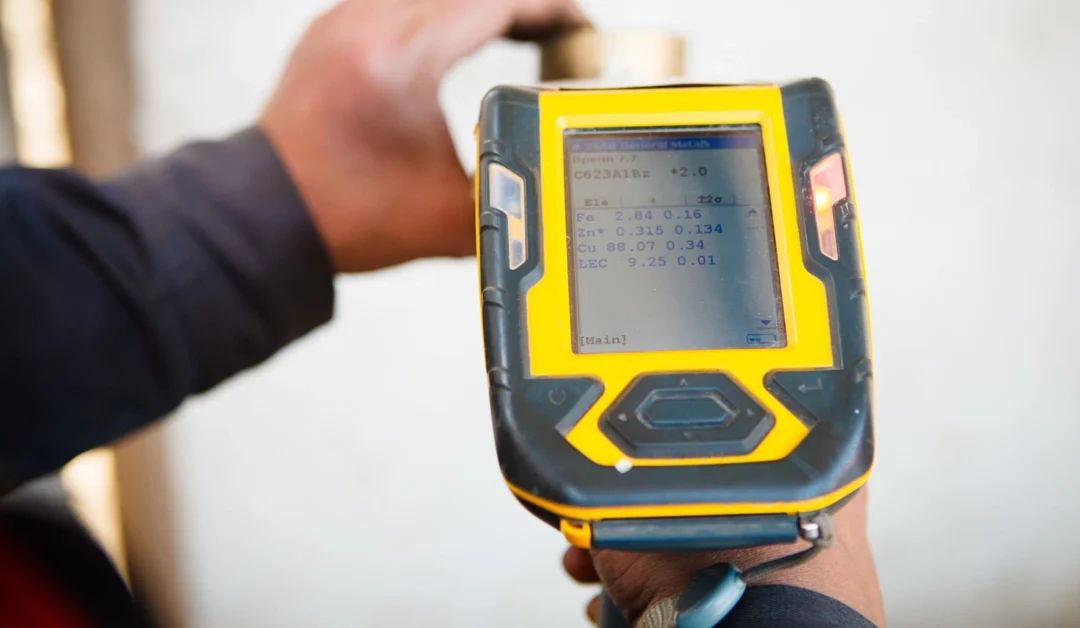
Handheld XRF analyzers provide fast, on-site ore analysis with little to no sample preparation. They reduce reliance on distant labs and deliver results in minutes. The fundamental parameters method enables standard-free analysis, though empirical or FP-based calibrations can be applied for specific ore types requiring higher precision. Models equipped with large-area Silicon Drift Detectors (SDD) excel at light element analysis (Al, P, Si, Mg, S) without helium purge — crucial for bauxite, limestone, and silicate-rich samples.
Instrumentation
Two main configurations are available:
- Standard Edition — 40 kV Tungsten anode tube with Si-PIN detector; covers elements from Cl to U.
- Light Edition — 40 kV Rhodium anode tube, five filters, and high-resolution large-area SDD; offers better energy resolution, lower detection limits, and faster measurements, especially for light elements (Mg, Al, Si, P, S).
Both versions are rugged, lightweight (~1.5 kg), support 8 hours of continuous operation on battery, and feature an intuitive interface with minimal training required.
Measurement Method
Natural samples are often heterogeneous, so sample preparation is recommended — especially for light elements: crush, grind, homogenize, and load into 32 mm XRF cups.
Common ore types analyzed include iron, copper, chrome, lead, tin, silver, and gold ores/concentrates.
Two primary geology modes:
- Mining mode — single pass (35 kV); ideal for low-grade ores and exploration; elements from Cl to U; minimal LOI influence.
- Mining 2pass mode — two passes (35 kV + 12 kV); enables light element analysis (Mg, Al, Si, P, S); suited for high-grade ores, minerals, and silicates (assumes low LOI).
For deeper accuracy, LOI can be determined separately and added as an undetectable component.
Conclusions
Handheld XRF analyzers reliably determine key elements in various ore types, with strong correlation to lab results when proper sample preparation is performed. Real-time data from portable devices significantly saves time and costs in exploration, mining, grade control, and ore processing.
Related posts
-
 XRF Analysis: Precise Metal Composition Testing
X-ray fluorescence (XRF) analysis has revolutionized metal composition testing across industries, offering...Einzelheiten
XRF Analysis: Precise Metal Composition Testing
X-ray fluorescence (XRF) analysis has revolutionized metal composition testing across industries, offering...Einzelheiten -
 XRF Analysis: Fast Material Composition Scanner
In today's fast-paced industrial environment, waiting days or weeks for laboratory results is no longer acceptable....Einzelheiten
XRF Analysis: Fast Material Composition Scanner
In today's fast-paced industrial environment, waiting days or weeks for laboratory results is no longer acceptable....Einzelheiten -
 XRF Analyzer: Accurate Element Identification
Accurate element identification forms the foundation of quality control, material verification, and compliance...Einzelheiten
XRF Analyzer: Accurate Element Identification
Accurate element identification forms the foundation of quality control, material verification, and compliance...Einzelheiten -
 XRF Fluorescence Analysis: Metals & Alloys Testing
X-ray fluorescence (XRF) analysis has transformed metals and alloys testing from a time-consuming laboratory process...Einzelheiten
XRF Fluorescence Analysis: Metals & Alloys Testing
X-ray fluorescence (XRF) analysis has transformed metals and alloys testing from a time-consuming laboratory process...Einzelheiten -
 XRF Testing: On-Site Metal Analysis Solutions
Traditional metal analysis required shipping samples to distant laboratories and waiting days or weeks for results....Einzelheiten
XRF Testing: On-Site Metal Analysis Solutions
Traditional metal analysis required shipping samples to distant laboratories and waiting days or weeks for results....Einzelheiten